
February Pruning & Grafting Guide: Fruit Trees, Vines, Roses & Olives

Updated: Sep 7
February is the month where hesitation does more damage than action. Buds are swelling, sap is preparing to rise, and the quiet window for dormant pruning is closing fast. Miss it, and you’re suddenly pruning into active growth. Rush it, and you risk removing the wrong wood.
This is not the month for drastic experiments. It’s the month for clear decisions, clean cuts, and restraint.
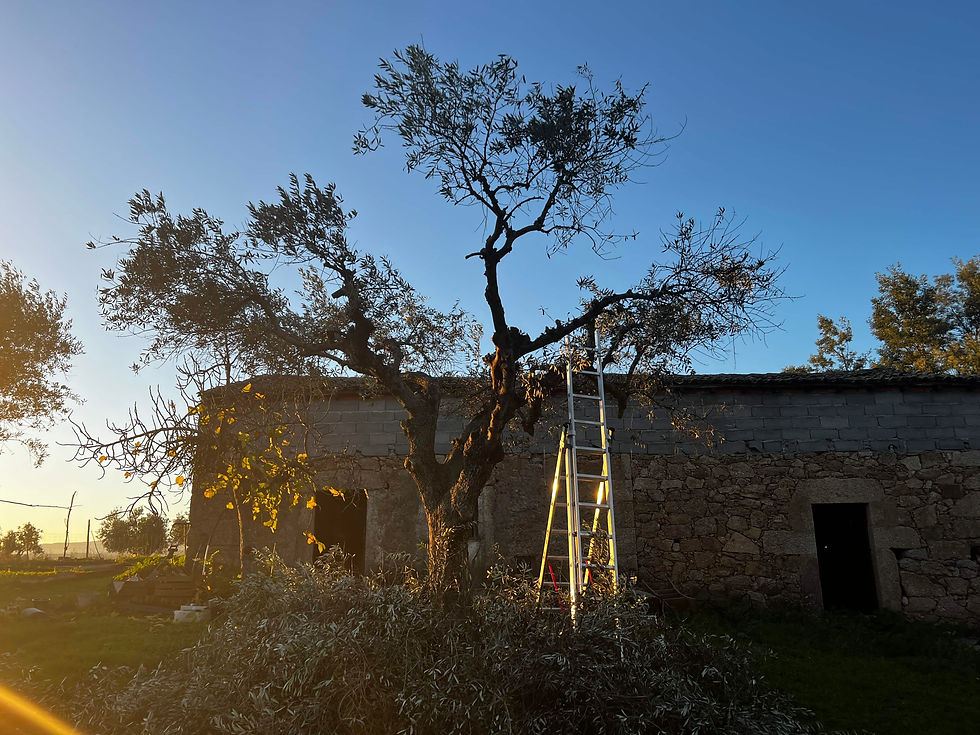
On our land here in Portugal, February is when pruning finally moves from the notebook to the field. Olives, a fig, our ‘Gala’ apple tree, and a handful of young roses are all still waiting their turn. Nothing dramatic. Just deliberate work that sets the tone for the whole growing season.
If you’ve been standing there with pruners in hand wondering “Am I too late?” or “Am I about to ruin this tree?” — this February pruning guide is for you.
Understanding Timing in This February Pruning Guide
February is often the last safe moment for dormant pruning in Mediterranean and temperate climates. Trees are still asleep, but they’re waking up.

Pruning now offers three major advantages:
Structure is visible. No leaves, no guessing.
Energy loss is minimal. Sap flow hasn’t fully started.
Healing is fast once growth resumes.
Wait much longer and you move into corrective pruning territory. That’s not wrong, but it’s different. Dormant pruning is about shaping the future, not fixing mistakes mid-season.
This matters most for fruit trees, vines, and olives. Citrus is the exception. More on that later.
What to Prune Now (and What to Leave Alone)
Fruit Trees and Vines Ready for February Pruning
These are safe, sensible candidates right now:
Apples and pears
Stone fruit (plums, peaches, apricots)
Fig trees
Grapevines
Kiwi vines
Roses (with restraint)

For all of them, start with the same framework before thinking about shape.
The “3 D’s” Rule
Before you design anything, remove only what clearly doesn’t belong:
Dead wood
Diseased wood
Damaged branches
If a branch is crossing, rubbing, or growing straight inward, it’s often next. This alone can account for 70 percent of good pruning.
Stop there if you’re unsure. A lightly pruned tree always outperforms a butchered one.

Tree Shape Made Simple: Open Vase vs. Central Leader
You don’t need diagrams to make good decisions. You need intent.
Open Vase (Olives, Figs, Some Stone Fruit)
We use this approach on our olives.
The goal is:
Light reaching the center
Air movement through the crown
Easy harvest without ladders

What we remove:
Old, unproductive wood
Vertical shoots shooting straight up
Crowding in the middle
What we keep:
Strong outward-facing branches
A lower, accessible canopy
We’re not chasing symmetry. We’re chasing function.
Central Leader (Apples and Pears)
Our ‘Gala’ apple tells a different story.
It was pruned two years ago and now shows:
One clear central leader
Two established layers of side branches
Here, the rule is simple:
The central leader must always be the highest point.
We thin side branches, not shorten them aggressively. The structure is already there. February is about maintaining hierarchy, not reinventing it.
Roses: Less Drama Than You Think
Our roses are still young. That changes everything.
At this stage, we do not:
Cut hard
Chase blooms
Force shape
Instead, February rose pruning is limited to:
Dead or weak wood
Obvious crossing branches
Thin growth from the rootstock or suckers
Heavy pruning will come later, once vigor earns it. Roses, like trees, need time before they need discipline.
Olives and Citrus: Where People Get Into Trouble
Olives tolerate pruning, but they don’t appreciate enthusiasm.

Common mistakes:
Removing too much at once
Chasing height instead of access
Cutting productive lateral branches
Our rule: thin, don’t scalp. A well-pruned olive still looks like an olive. If it looks shocked, it probably is.
Citrus: Not a February Job
Citrus does not belong in the February pruning queue.
Reasons:
Sensitive to cold damage
Actively holding energy in foliage
Better pruned after frost risk passes
If you must touch citrus now, limit it to:
Dead wood only
Broken branches
Structural pruning waits for spring.
A First Look at Grafting (Without Overcomplicating It)
February is prime time for grafting because:
Rootstock is dormant
Cambium layers align well
Healing starts quickly once growth resumes
For home orchardists, two methods matter:
Whip-and-tongue graft for young, similarly sized wood
Cleft graft for top-working older trees
This is not the post to master grafting. It is the moment to decide whether you’ll try this year or observe and plan for the next.
If pruning is surgery, grafting is transplantation. Respect the learning curve.
Tools, Safety, and Clean Cuts
Sharp tools are not optional. They’re the difference between healing and infection.
February pruning basics:
Sharp bypass pruners
Clean saw for thicker branches
Disinfect tools between trees
Gloves and eye protection
A clean cut heals faster than a perfect plan executed with dull blades.
February Is About Direction, Not Perfection
This month isn’t about fixing everything. It’s about setting direction.
On our land, olives are being opened for light. A fig is being simplified. An apple tree is being respected, not reshaped. Roses are being observed more than corrected.
That’s February pruning done right.
If you’re unsure, stop early. Trees forgive patience far more easily than overconfidence.
And if you want deeper, practical breakdowns for each species, that’s exactly what we’re building inside the Tough Kraut plant library.
Herman's Tough Kraut Fixes: Common February Pruning Guide Challenges
February pruning causes hesitation for a reason. You’re working in a narrow window where timing, restraint, and clarity matter more than enthusiasm. The good news is that most pruning mistakes are predictable and easy to avoid once you understand what the tree is actually responding to.
Q: I think I under-pruned. Is that bad?
A: No. Under-pruning is almost always better than over-pruning. You can adjust later. You can’t reattach branches.
Q: I see buds swelling. Am I too late?
A: Not necessarily. Light pruning is still fine. Avoid heavy structural cuts once sap is clearly rising.
Q: My olive tree exploded with vertical shoots last year. What now?
A: That’s a response to over-pruning. Thin selectively this year and give it time to rebalance.
Q: Can I graft and prune on the same day?
A: Yes, but keep them mentally separate. Prune first, graft second, and don’t rush either.
Q: What if I’m still unsure where to cut?
A: Walk away. Look again tomorrow. February rewards restraint.
Recommended Books & Resources
Books
Grow a Little Fruit Tree by Ann Ralph
The small-orchard classic for keeping fruit trees compact with smart cuts, so you harvest from the ground instead of from a ladder you do not trust.
The Pruning Book by Lee Reich
A calm, practical guide that replaces “pruning fear” with simple rules, solid technique, and the why behind each cut.
RHS Pruning & Training by Christopher Brickell
A step-by-step reference with an A–Z approach across tons of plants, perfect when you are staring at a rose or vine thinking, “What exactly am I looking at?”
The Grafter’s Handbook, 6th Edition by R. J. Garner
The deep-dive grafting bible that takes whip-and-tongue and cleft grafts from “mystery craft” to repeatable skill.
Resources
FELCO F2 Pruning Shears
A buy-once, cry-once bypass pruner with replaceable parts that makes clean cuts feel almost unfairly easy.
Silky Pocketboy Folding Saw (170 mm, medium teeth)
The pocket-sized saw that turns “too thick for pruners” into a smooth, clean cut instead of a chewed branch stub.
Parafilm grafting tape
A stretchy wrap used by grafters because it seals in moisture while still letting the graft breathe, which is a game-changer for beginners.
Tough Kraut Resources
Want the exact pruning, grafting, and tool-care gear we trust on our own Quinta? Click Tough Kraut Resources for a curated, SEO-friendly shortlist that saves you hours of guesswork and bad buys.


Comments