
Top 10 Essential Power Tools for Homestead DIY Projects

When we first moved onto our off-grid land in Central Portugal, I thought the hard part would be growing food, managing water, and learning the rhythm of the seasons.
Then the real homestead work began.
A fence needed fixing. A greenhouse needed anchoring. Timber had to be cut. Granite stones needed cleaning. Rebars had to be cut for the ring beam and floor slab. The old stone house had to be rebuilt into something that could last, with a granite ground floor and a timber first floor.
That is when I learned a simple truth: the right tool does not make the job easy, but it makes the job possible.

Most of my current power tools are from the Bosch Professional 18V battery system. This is not because every homesteader needs that exact brand. It is because once you start working off-grid, one solid battery platform makes life simpler. Fewer chargers, shared batteries, strong build quality, better spare part access, and less hunting around when the next job appears.
Two sayings guide most of my tool choices:
“I am too poor to buy cheap.”
And the classic: “You buy cheap, you buy double.”
That does not mean every beginner should buy professional tools on day one. It means you should buy tools with a plan. Start with what you will use often. Choose tools that can handle real work. Then expand as your projects demand it.
Stick around until the end for Herman’s Tough Kraut Fixes, where I’ll answer the common power tool questions that come up when you start building, fixing, sanding, cutting, and occasionally wondering why the screw bit has vanished again.
Why Power Tools for Homestead DIY Projects Matter
A homestead is not one project. It is hundreds of small jobs stacked on top of each other.
One week you are building a raised bed. The next week you are fixing a chicken coop door, trimming timber, cutting tile, drilling into masonry, sanding painted wood, or working under bad light because the sun has disappeared behind the hills and you still have “just one more thing” to finish.
That is why power tools for homestead DIY projects need to do more than look good on a shelf. They need to earn their keep.
On a homestead, tools support resilience. They help you repair what breaks instead of waiting for someone else. They help you adapt old materials. They turn scrap wood into useful parts. They help you build systems that fit your land, your house, and your budget.
There is also a permaculture angle here. Good tools help reduce waste. A rough board can become a shelf. Old timber can be planed and reused. A broken bracket can be replaced. Stones, steel, and timber can be shaped instead of thrown away. The tool is not the solution by itself, but it gives your hands more options.
For us, that matters every week. Our renovation is not a clean new-build project with perfect materials. The ground floor walls are old granite stones. The first floor is timber. Around it, we have garden beds, irrigation, fences, animal areas, water systems, and the daily chaos of off-grid life.
So this list is not theory. These are the power tools we actually use.
Tough Tip: Do not buy tools based only on what looks impressive. Buy based on repeat problems. If the same task comes back again and again, that tool has probably earned a place.
The Core Cutting and Drilling Tools We Use Most
Some tools are the backbone of DIY work. These are the ones that come out again and again, whether the job is simple, dusty, loud, or just more awkward than expected.
1. Battery Drill: Bosch Professional GSR 18V-10 C
A good battery drill is the first power tool I would recommend to most homesteaders.

The Bosch Professional GSR 18V-10 C is the kind of tool that quietly becomes part of daily life. It drives screws, drills pilot holes, helps assemble frames, fixes hinges, mounts brackets, and saves your wrist from endless hand-screwing.
On our Quinta, a drill is useful for almost everything. Timber frames, shelving, raised bed repairs, greenhouse work, simple furniture fixes, and all those odd little jobs that appear when you live on land.
For beginners, this is the best first power tool because it builds confidence. You can start with simple projects and still use the same tool as your skills grow.
Tough Tip: Buy good drill bits and screw bits. A strong drill with poor bits is like a tractor with bald tires. It makes noise, but the work suffers.
2. SDS Rotary Hammer: Bosch GBH 18V-26 F
This is not just a hammer drill. The Bosch GBH 18V-26 F is an SDS rotary hammer, and that matters.
A normal drill works well for wood and lighter jobs. An SDS rotary hammer is made for tougher material: masonry, stone, concrete, and chisel work. On our granite stone house renovation, this tool earns its keep.
I use it for smaller chisel jobs and for cleaning granite stones with a bushing tool. That may sound niche, but when your house is built from old granite, stone work stops being niche very quickly. Granite does not care how motivated you are. It wants the right tool.
This tool also fits well into renovation work where stone, old mortar, and concrete details keep appearing. It is powerful enough for serious DIY use, but still part of the 18V battery system, which helps when working off-grid or away from easy power access.
Tough Tip: Let the rotary hammer do the work. Pressing harder does not make stone softer. It just makes your arms complain sooner.
3. Circular Saw: Bosch GKS 18V-57 G
The circular saw is one of the most useful cutting tools for homestead projects.
The Bosch GKS 18V-57 G is ideal for cutting boards, panels, framing timber, and sheet material. It is more mobile than a table saw, which matters when the material is heavy, long, or already sitting near the project site.
On a homestead, you often cut where the work happens. Near the greenhouse. Beside the house. Next to a pile of timber that you promised yourself you would organize months ago.
A circular saw is great for rough cuts and practical construction cuts. It is one of those tools that makes timber work feel less like a battle.
4. Angle Grinder: Bosch GWX 18V-15 C
The angle grinder is one of the most useful and most serious tools on this list.
Our Bosch GWX 18V-15 C is used for stone work, tile work, and cutting metal. I also use it for cutting rebars for our ring beam and floor slab. That alone makes it a key tool in our renovation story.

An angle grinder can cut, grind, clean, shape, and rescue many awkward jobs. It can handle metal, stone, tile, bolts, and other stubborn materials. But it demands respect. Sparks, dust, noise, and fast-spinning discs are not casual things.
This is not the tool I would hand to a beginner without a safety talk. Eye protection, ear protection, gloves, proper discs, and full focus are non-negotiable.
The Saws That Make Timber Work Cleaner and Faster
A homestead has a strange appetite for timber. Boards become shelves, frames, gates, supports, planters, storage racks, trim, cladding, and odd “temporary” fixes that somehow stay in place for three years.
That is why we use several saws. They overlap a little, but each one has a role.
5. Table Saw: Bosch GTS 18V-216
The Bosch GTS 18V-216 table saw is the tool for repeatable and more accurate cuts.
A circular saw is great for mobile cutting. A table saw is better when you need straight, repeat cuts or when you want to rip boards down to width. This is useful for cleaner woodworking, small construction parts, trim pieces, and more precise timber work.
For many beginners, a table saw is not the first tool to buy. But once your projects become more detailed, it starts saving real time. It also improves consistency. And consistency is what makes DIY projects look less like “good enough from far away.”
On our homestead, the table saw fits well into timber tasks linked to the house renovation and general construction work.
Tough Tip: Respect the table saw every time. Clean setup, steady feed, and no loose sleeves. This tool rewards patience and punishes distraction.
6. Sliding Mitre Saw: Bosch GCM 18V-216
The Bosch GCM 18V-216 sliding mitre saw is all about clean, repeatable crosscuts.
This is the tool I like for cutting studs, battens, trim, framing pieces, and angled cuts. If you are building with timber, especially in a house renovation, it quickly becomes one of those tools that makes you wonder how you managed without it.
For our renovation, where the granite ground floor meets a timber first floor, clean timber cuts matter. The mitre saw helps make pieces fit better, faster, and with less fiddling.

It is especially useful when you need several pieces cut to the same length. That sounds simple, but repeat accuracy can save a lot of time and frustration.
Tough Tip: Mark once, cut many only after testing the first piece. Repeating a wrong cut perfectly is still wrong. Ask me how I know.
7. Multi-Cutter: Bosch GOP 18V-28
The Bosch GOP 18V-28 multi-cutter is the tool for awkward jobs.
It cuts where bigger saws cannot reach. It trims, scrapes, slices, and sneaks into corners. It is useful for renovation work, door frames, small cutouts, old material removal, and those annoying places where no normal tool seems to fit.
A multi-cutter is not the strongest tool in the battery family, but it may be one of the most helpful. It is the problem-solver. The tool you grab when the proper method no longer fits the real situation.
On old buildings and homestead projects, “real situation” happens often.
Tough Tip: Let the blade do the work and keep spare blades ready. A dull multi-tool blade turns a clever tool into a buzzing spoon.
The Finishing Tools That Make Projects Look Less Homemade
Rough building gets the structure done. Finishing tools make the work nicer to live with.
This matters when your DIY projects are not only outside in the rain, but inside your future home. A board that is smooth, level, and ready for paint or oil feels different from one that still looks like it came straight from the saw pile.
8. Planer: Bosch GHO 18V-LI
The Bosch GHO 18V-LI planer is useful when timber needs shaping, trimming, or cleaning up.
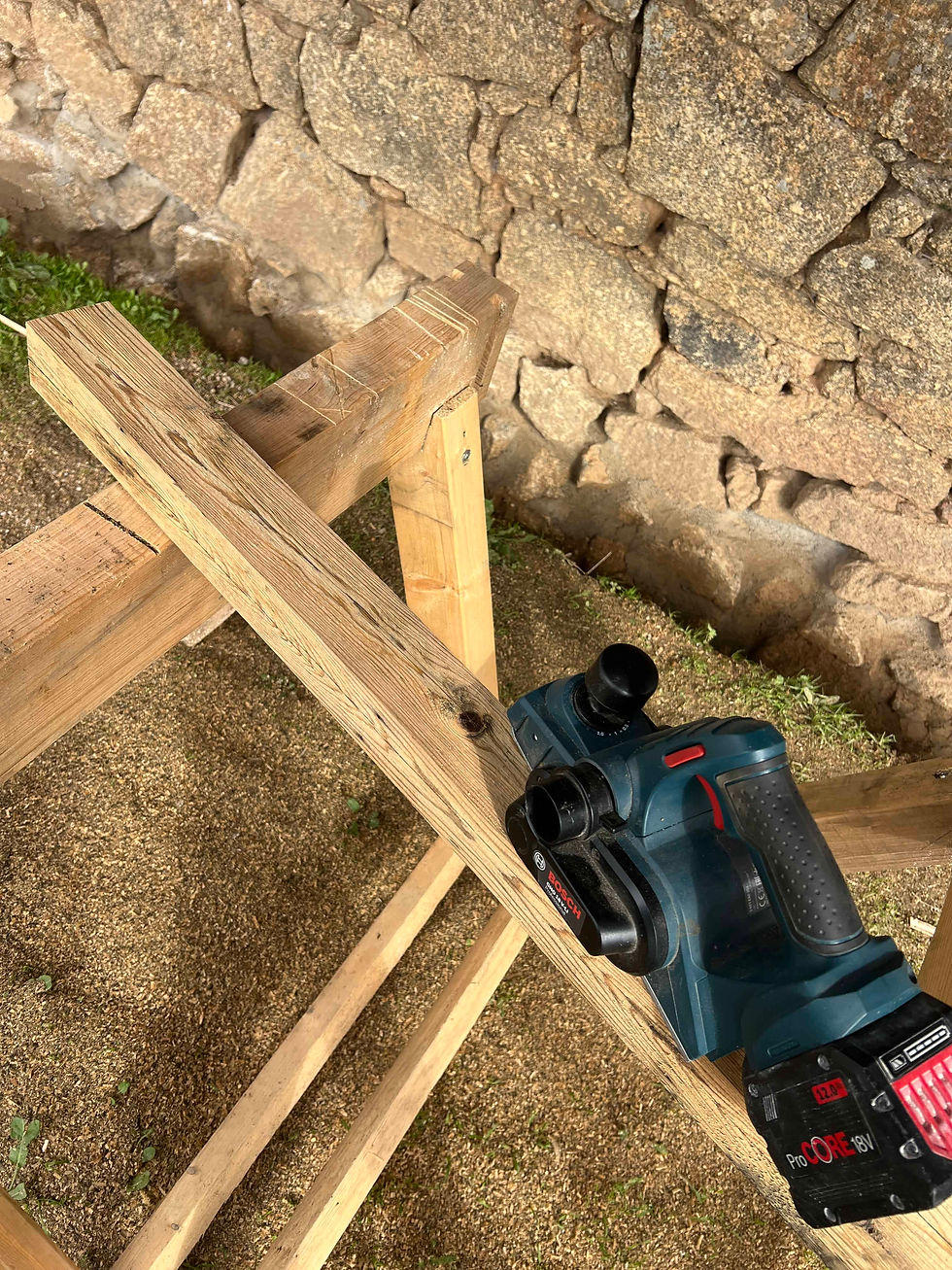
Old timber, rough boards, and real renovation material rarely behave like perfect store-bought pieces. A planer helps adjust doors, smooth edges, reduce thickness, and make boards fit where they need to fit.
This tool is not always the first one a beginner needs, but it becomes valuable when you work with reused timber or build more precise projects. On a homestead, salvaged wood often has a second life. The planer helps make that second life less splintery.
Tough Tip: Take shallow passes. Removing too much too fast can ruin a board faster than you can say, “That was the good piece.”
9. Orbital Sander: Bosch GEX 18V-125
The Bosch GEX 18V-125 orbital sander gets a lot of use in our house project.
MuDan uses the orbital sander often because she does most of the paint work at our house. That makes this tool part of the finishing rhythm of the renovation. Sanding may not feel exciting, but good paint work starts with good prep.
An orbital sander smooths timber, prepares surfaces, removes rough patches, softens edges, and helps old or new wood take paint, oil, or finish more evenly.
For homesteaders, this matters beyond house renovation. It is useful for shelves, tables, benches, planters, doors, window frames, reused timber, and any project where hands will touch the final surface.
Tough Tip: Sanding is not a punishment. It is the difference between “I built this” and “I built this, and I still like touching it.”
10. Worklight: Bosch GLI 18V-1900
The Bosch GLI 18V-1900 worklight may not look as exciting as a saw or rotary hammer, but it belongs in the top 10.
Good light changes the work. It helps you see cut lines, screws, cracks, gaps, sanding marks, mortar joints, dust, and all the tiny things that become big problems when missed.

On a homestead, work rarely happens in perfect lighting. Old stone buildings are dark. Sheds are dark. Winter afternoons are short. Sometimes the job runs late because stopping halfway would create a bigger problem tomorrow.
A strong battery worklight is simple, practical, and surprisingly important. It also fits the shared 18V battery system, which makes it easy to keep in rotation.
Tough Tip: If you cannot see the work clearly, you cannot judge it clearly. Good lighting is a safety tool, not a luxury.
Battery Systems, Brand Tools, and Buying Once
I am not saying every homesteader must buy Bosch Professional tools. I am saying that a good battery ecosystem matters.
Once you own several battery-powered tools, the battery platform becomes part of the system. Shared batteries reduce clutter. A common charger saves time. Spare batteries move between tools. If one tool is not in use, its battery can power the next job.
For off-grid life, battery tools also make sense. They reduce the need to run long extension cords, and they can be charged when solar power is available. That fits our life well.
Brand tools also tend to have better support, stronger warranty systems, and better spare part access. That does not mean they never fail. It means you have a better chance of repair, replacement, and long-term use.
Cheap tools can work for light jobs. But on a homestead, tools often face dust, stone, wood, weather, and repeated use. This is where cheap can become expensive.
The saying is true: “You buy cheap, you buy double.”
What I Would Buy First as a Beginner
Not everyone needs all ten tools at once. In fact, most beginners should not start that way.
If I had to build up slowly, I would begin like this:
First, buy a good battery drill. It is the most useful all-round tool for small builds and repairs.
Second, add a circular saw if you work with timber. This opens the door to raised beds, shelves, frames, gates, and basic construction.
Third, get an angle grinder if you work with metal, stone, tile, or renovation materials. Use it safely and respect it.
Fourth, add an SDS rotary hammer if you deal with masonry, concrete, stone, or old buildings.
Fifth, add a worklight. It sounds boring, but you will use it more than expected.
After that, choose based on your projects. If you do lots of repeat timber cuts, get a mitre saw. If you need accurate ripping, add a table saw. If you do finish work, get the orbital sander. If you work with rough timber, add the planer. If renovation throws strange corners at you, the multi-cutter will become your friend.
The best tool order depends on the work you actually do.
Tough Tip: Buy for your next three real projects, not your fantasy workshop. Real projects tell the truth.
Tool Lessons from Our Off-Grid Renovation
Our granite stone house renovation has taught me that tools are not just about speed. They are about confidence.
When you know you can cut the timber, drill the stone, sand the surface, shape the board, or finish the job after sunset, you approach projects differently. You stop waiting for perfect conditions and start solving problems.
But tools also teach humility.
The wrong blade slows everything down. The wrong drill bit ruins your patience. Dust goes everywhere. Batteries run out when you thought they were full. And the tool you ignored for months suddenly becomes the hero of the day.
That is homestead DIY in a nutshell. It is not about owning every tool. It is about learning which tools help you keep moving.
The more we build, repair, and renovate, the more I value tools that are reliable, practical, and ready when needed. A good tool does not replace skill. It helps skill grow.
Build Skills, Not Just Tool Shelves
The best power tools for homestead DIY projects are the ones that help you do real work on real land.
For us, that means a battery drill, SDS rotary hammer, table saw, circular saw, angle grinder, sliding mitre saw, multi-cutter, planer, orbital sander, and worklight. Each one has earned its place through actual projects on our Quinta, from woodworking and painting to stone cleaning, tiling, rebar cutting, and renovation work.
If you are just starting, do not feel pressured to buy everything at once. Start with the tool that solves your most common problem. Learn it well. Add the next one when the work demands it.
Self-reliance is built one skill at a time. And sometimes, one battery charge at a time.
If you are part of the Kraut Crew, keep building, keep learning, and keep sharing what works. The goal is not a perfect tool collection. The goal is a more capable life.
Herman’s Tough Kraut Fixes: Common Challenges Using Power Tools for Homestead DIY Projects
Choosing power tools for homestead DIY projects can feel overwhelming at first. This Troubleshooting and FAQ section covers the common questions I would ask before spending money, based on real work with timber, granite, paint prep, metal, tile, and off-grid repairs.
Q: Do I need all ten power tools to start homesteading?
A: No. Start with a good battery drill, then add tools based on your projects. A beginner building raised beds needs different tools than someone renovating a granite stone house.
Q: Are battery tools strong enough for serious homestead work?
A: Yes, if you buy quality tools and match the tool to the job. My Bosch Professional 18V tools handle most of our regular work well, from timber cuts to drilling and sanding. For very heavy work, corded or rented tools may still make sense.
Q: Should I buy cheap tools first and upgrade later?
A: Only for tools you rarely use or are testing gently. For tools you use often, cheap can become expensive fast. “You buy cheap, you buy double” is painfully true when a tool fails halfway through a project.
Q: What is the most useful first power tool?
A: A battery drill. It helps with screws, pilot holes, brackets, hinges, repairs, frames, and basic builds. It is the tool most likely to come out every week.
Q: What tool surprised you most?
A: The worklight. It sounds simple, but good light makes work safer and cleaner. In old buildings, sheds, winter afternoons, and awkward corners, visibility is priceless.
Q: What about dust cleanup?
A: I have the Bosch GAS 18V-1 vacuum cleaner, but I do not find it very strong for my use. I often prefer the Bosch GBL 18V-120 blower for clearing sawdust. For indoor renovation dust, though, blowing dust around is not enough. Use masks, ventilation, and proper dust control.


Comments