
Greenhouse Gardening in Portugal: How Our Greenhouse Changed the Quinta

For the first couple of years on our Quinta, annual vegetable growing felt unpredictable at best and slightly humiliating at worst.
We direct-sowed seeds into dry soil, battled inconsistent watering, and celebrated every cucumber like it was a major farm win. Some plants survived. Many simply vanished into the Mediterranean chaos of ants, heat, wind, snails, and beginner impatience.
Then we added a greenhouse. Not the big one at first. That came later. Our first greenhouse was a small 2 x 3 m (6.6 x 9.8 ft) budget setup for €99.99. It was not fancy, not strong, and definitely not built for heroic storm tales. But it helped keep frost-sensitive young trees alive and gave us a protected place to start seedlings in spring.
Then one winter storm blew it up and tore the plastic cover away. Still, that little greenhouse taught us something important: protected growing space could change the way we grow food on our land.
In January 2024, we installed a proper 5 x 14 m (16.4 x 45.9 ft) greenhouse on our second terrace. Suddenly, annual vegetable growing became less random. Seedlings had a better start. Tomatoes began self-seeding in the beds. Peppers had more time to ripen. Tender nursery plants had shelter. And during cold, wet winter days, we had a dry, wind-protected place to work when the rest of the homestead said, “Nope. Not today.”
The greenhouse did not make gardening effortless. It made it more reliable.
Looking back now, greenhouse gardening Portugal conditions taught us that protected growing space is not really about perfection. It is about reducing uncertainty enough that vegetables, seedlings, nursery plants, and even gardeners themselves get a more reliable chance to succeed.
Stick around until the end for Herman’s Tough Kraut Fixes, where I cover the greenhouse troubleshooting and FAQ lessons I wish someone had handed me before I started.
Greenhouse Gardening Portugal: What Changed First
When we arrived on our land in Central Portugal, I was full of energy and short on patience. That is not always a good mix.
In the first year, we tried direct sowing many annual vegetables without a proper indoor seed-starting space. We were still living in a mobile home trailer, space was tight, and our systems were basic. Seeds went into outdoor beds, we watered as best we could, and then nature gave us a very honest review.
Ants carried seeds away. Dry soil made germination patchy. Some seedlings came up, then disappeared. Watering was not yet well organized. Wind and heat added extra stress. And because we were also setting up fencing, storage, water systems, and a renovation plan, the vegetable garden did not always get the calm daily care it needed.
In Year 2, we improved. Cucumbers and zucchini did better, and we started to understand our land more. By Year 3, eggplants and chili peppers showed us what was possible with better protection, better timing, and stronger seedlings.
But the real shift came when greenhouse vegetable growing became part of the system.
A greenhouse gives annual vegetables what they crave most: a more stable start. Not perfect conditions. Just fewer wild swings.
Tough Tip: If your outdoor sowings keep failing, do not assume you are bad at gardening. You may simply need a better seed-starting system. Seeds are tiny. Mediterranean weather is not.

The Tiny Greenhouse That Proved the Point
Our first greenhouse was a quick fix. During our first year, we still had several frost-sensitive young trees that were not planted in their final spots. I had not yet learned the full value of patient observation, so some plants had arrived before their homes were ready. To protect them, I bought a small 2 x 3 m (6.6 x 9.8 ft) greenhouse for €99.99.
I did not expect much from it. To be fair, it gave us more than expected. It somehow survived its first winter and helped us keep smaller trees alive. In spring, it also helped us germinate seedlings and create a basic plant nursery corner.
Then a storm tore the plastic cover away. Structurally, that little greenhouse failed. As an experiment, it succeeded.
It showed us that even a cheap covered space could change our growing season. The seedlings had protection. The potted trees had shelter. We had a place to work with plants before the outdoor beds were ready.
That experience pushed us toward the next step: a proper greenhouse built for long-term use.
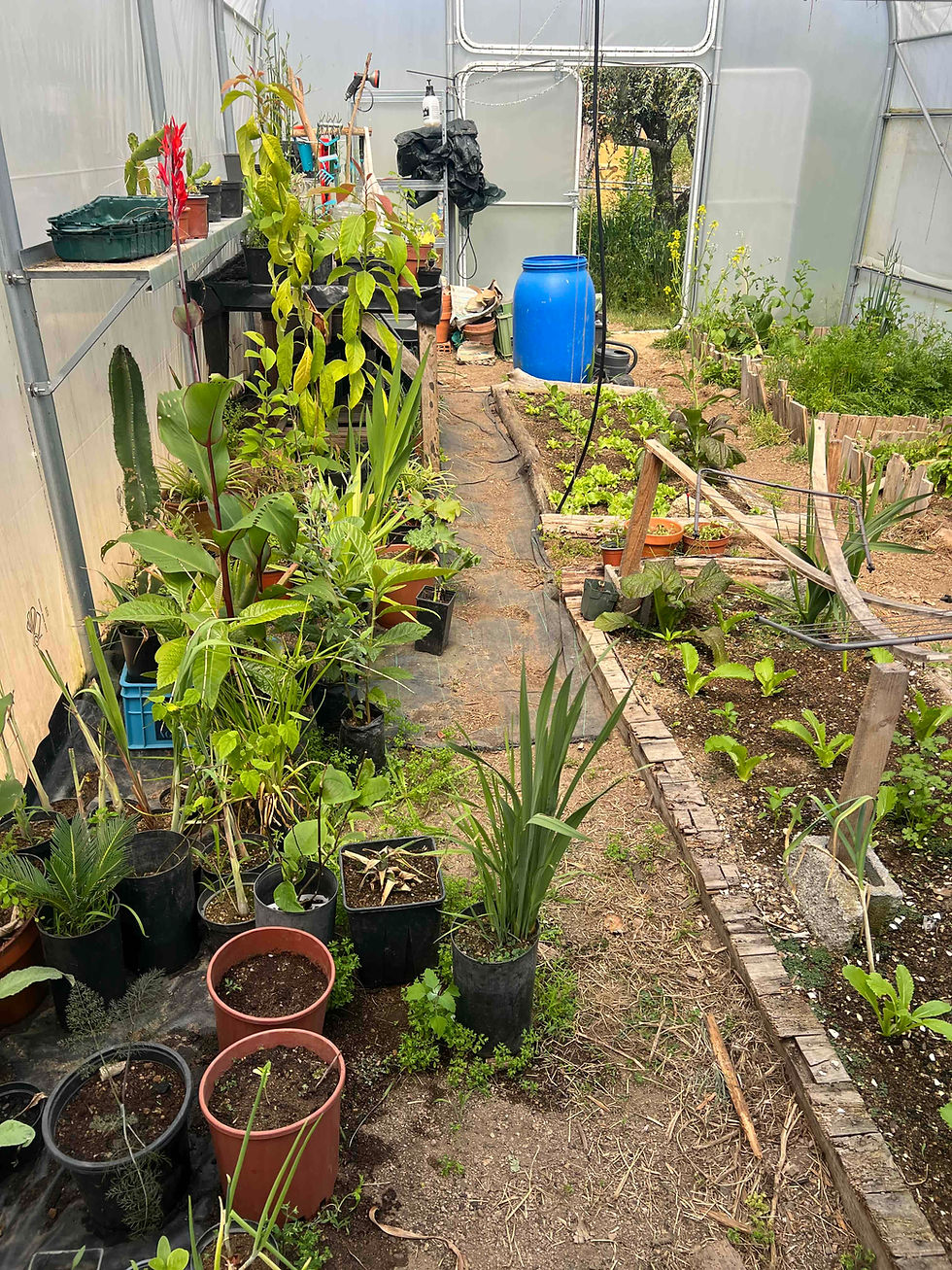
Installing a Proper Greenhouse on the Quinta
At the beginning of January 2024, we installed our current greenhouse. We ordered it from a Portuguese company called Barcelestufas. The greenhouse cost €3,781, including the full installation. Two workers came out, stayed for two days, slept at a nearby B&B, dug the footing holes, and installed the structure.
The final size is 5 x 14 m (16.4 x 45.9 ft), giving us 70 m² (753 sq ft) of covered growing space. The center height is 3.80 m (12.5 ft), which gives plenty of air volume and makes the space feel open rather than cramped.

I chose the maximum footprint that made sense for the terrace. The greenhouse sits on our second terracer, between the upper vegetable terrace and the flat food forest section. That location matters. It is close enough to the main growing zones, but it also sits in a place where the surrounding land, terrace shape, and nearby vegetation help buffer wind.
The frame is made from galvanized tubes set into concrete footings below ground. The plastic film is buried about 30 cm (12 in) into the ground around the edges. The shorter sides have doors and tilting window openings. On the side facing the food forest, we added a roll-up window to improve summer airflow.
That airflow is not a luxury. In Portugal, a greenhouse can turn from cozy to sauna faster than a cucumber can look offended.
Last winter, the greenhouse survived three storms in a row, including Storm Kristin, without damage. Storm Kristin was severe enough that Reuters reported wind gusts over 200 kph in Portugal and widespread damage. I believe our greenhouse survived not only because it was well built, but also because its terrace position and surrounding vegetation helped reduce the full force of the wind.
Tough Tip: A greenhouse is not just a structure. It is a site decision. Footings, frame strength, wind direction, surrounding trees, slope, and exposure all matter.
How the Greenhouse Improved Seed Starting
The biggest greenhouse change was not the harvest. It was the start.
Seedlings are where annual vegetable growing often succeeds or fails. Once a tomato, pepper, lettuce, or pak choi plant is strong, you have options. When it is still tiny, it is a snack with leaves.
This year, we finally got the greenhouse back on track after a long phase where the granite stone house renovation pulled most of our time and energy. For a while, the greenhouse was semi-abandoned. Self-seeded tomatoes filled the DIY raised beds, and much of the space was used for potted nursery plants.
Useful, yes. Organized, not always. Now we are rebuilding the system.
One of the best upgrades I made is an elevated ebb-and-flood-style table for seed trays. It is not a high-tech hydroponic setup. It is a practical table with slightly raised edges, covered with plastic foil, so pots and seed trays stay moist longer and do not dry out too fast.

That one change helps a lot. Small pots dry quickly in spring sun, even inside a greenhouse. The table buys time and makes seed starting more forgiving. The winter of 2025/26 also changed things because it was the first time we had more indoor space and a wood burner after years in the mobile home. That meant I could start seeds earlier, with mixed but useful results.
This year, the greenhouse has supported white radish, different rocket varieties, China cabbage, self-seeded tomatoes, peppers such as El Cayenne, Sweet Chocolate, and Padrón, plus eggplant, basil, lettuce, pak choi, cardoon, and several leafy greens.
Not every tray is perfect. Some seeds still fail. Some seedlings still get eaten. But the success rate is far better than tossing seed into a dry outdoor bed and hoping the ants are busy elsewhere.
Tough Tip: Seed starting does not need to be perfect. It needs to be repeatable. A simple moist tray table can beat fancy gear if it helps you show up more often.
Greenhouse Vegetable Growing Benefits We Noticed Fast
The greenhouse changed annual vegetable growing in several practical ways. First, it extended the season. Tomatoes, peppers, eggplants, and basil all gain time when they start protected and stay warmer at the edges of the season. In a Mediterranean climate, summer heat is not the only issue. Spring can be windy, nights can stay cold, and autumn can switch from warm to wet in a blink.
Second, it improved protection. Heavy rain does not flatten seedlings. Wind does not shred tender leaves. Larger wildlife cannot simply walk in and browse the buffet when the doors are closed.
Third, it gave us a nursery space. This may become important for a future plant nursery business, but it already matters now. Every cutting, seedling, division, and potted plant we keep alive is a form of stored value. A propagated plant is not truly “free,” because it takes time, space, water, and care. But it is still one of the best returns on effort a homestead can get.

Fourth, it gave us room to experiment with plants that may not enjoy our harsher outdoor conditions. Inside the greenhouse, we have a planted-in-the-ground section with a small banana circle, lemongrass, Japanese ginger, two clumps of Canna indica, a pineapple plant, artichoke, rosemary, avocados, finger lime, and more lemongrass.
That mix may sound a bit like the plant version of “everyone into the lifeboat,” but it works as a living trial zone. We can observe what handles the greenhouse climate, what struggles, and what deserves more space later.
Finally, the greenhouse gave us a better work space. During cold, windy, rainy autumn and winter days, working inside a dry, sheltered greenhouse feels like a gift. When the rest of the land is wet, muddy, and rude, the greenhouse still invites you in.
Tough Tip: Do not measure a greenhouse only by tomatoes. Count seedlings, cuttings, overwintered plants, winter work days, saved nursery stock, and learning time. That is the real yield.
The Irrigation Lesson: It Never Rains Inside
A greenhouse protects plants from rain, which is both good and annoying. Good, because you control moisture. Annoying, because you must control moisture.
We set up a Gardena Micro-Drip-System to automate irrigation during summer and for times when we might be away for a few days. This was a big step forward, but it came with a learning curve.

All our water comes from our well. The well is not yet covered, so algae and small particles can enter the system. Those particles jammed the irrigation nozzles. I added two extra filters, which helped, but created a new job: cleaning the filters every 3 to 5 days.
That means the system works well for normal life. It does not yet make longer trips fully hands-off. If we leave for more than a short period, we still need a neighbor to check the greenhouse and clean the filters if needed.
That is an important lesson. Automation reduces work, but it does not remove responsibility. Especially off-grid, every system has a weak point. In our case, the weak point is water quality before filtration.
For now, the system still makes sense. It keeps seedlings and annual vegetables more stable through summer heat. It buys us time. It reduces hand watering. But it also reminds us that the next upgrade is not another nozzle. It is a better-protected well and easier filter access.
The Problems Nobody Talks About Enough
Greenhouses are often sold as magic garden boxes. They are not. They solve some problems and create others.
The first big one is heat. In Portugal, one day can feel like all four seasons lined up for inspection. You can have hot sun in the day, cold air at night, sudden moisture, and wind that makes every open door a decision.
Ventilation becomes a daily rhythm. Open doors and windows early enough, or the greenhouse gets too hot and plants bolt. Close them early enough, or you lose the warmth you wanted for the night.
The roll-up side window helps a lot in summer. So do the doors and tilting windows on the short sides. But airflow still needs attention. A greenhouse with no airflow becomes a fungal spa, and not the relaxing kind.
The second problem is pests. This year, snails have eaten their fair share of young, fresh, juicy vegetables. A greenhouse can block larger animals, but it does not block every small hungry creature. In fact, if snails get inside, they may enjoy the protected buffet even more than you do.
The third problem is space creep. A greenhouse fills itself. Seedlings, pots, tools, nursery stock, volunteer tomatoes, “temporary” plants, and experimental crops all move in. Before long, your greenhouse starts to look like a plant party where nobody wants to leave.

That is not failure. It is a sign that the space is useful. But it does mean you need paths, zones, and the courage to remove plants that no longer serve the system.
Tough Tip: A greenhouse needs airflow, water, and ruthless tidying. Ignore any one of those, and nature will send a reminder with slime trails, mold, or a tomato jungle.
Was the Greenhouse Worth the Investment?
For us, yes. The cost was not small. But it included a large 70 m² (753 sq ft) structure, installation, footing holes, and two days of work by two people. This was not a little pop-up cover from a supermarket aisle. It became part of the homestead’s core growing system.
A greenhouse also changes how I think about food value. If you drive at least 50 km (31 miles) round-trip to a supermarket, spend fuel and time, then buy vegetables grown far away, wrapped in plastic, and shipped hundreds or thousands of kilometers, the shelf price is not the full cost.
The greenhouse does not give us free vegetables. Seeds, water, compost, irrigation parts, time, and repairs all count. But it gives us more control. More freshness. More resilience. More propagation. More learning. And potentially, in the future, more nursery stock for a small plant business.
It also lets us grow food and plants in a way that fits our life. We can start seedlings earlier, protect plants longer, test new crops, overwinter sensitive plants, and work under cover when the weather outdoors is miserable.

That is a different kind of return. Not just money back. Life back.
Simple Greenhouse Tools That Made Growing Easier
You do not need to fill a greenhouse with fancy equipment on day one. Start with the basics that solve real problems.
A few tools have made our greenhouse easier to manage:
Strong seed trays and pots for repeated sowing
A raised seedling table that holds moisture longer
A greenhouse thermometer to track heat swings
Drip irrigation for summer watering
Extra filters for well-fed irrigation systems
Shade cloth or partial shading for hot periods
Good pruning snips for tomatoes, peppers, and nursery plants
Plant clips, strings, or supports for climbing crops
Waterproof seed storage boxes for damp greenhouse conditions
For more practical greenhouse gear, propagation tools, irrigation solutions, and off-grid gardening equipment, check out our Tough Kraut Toolkit & Resources. It’s a curated collection of the tools, books, systems, and real-world gear that help us grow food, build resilience, compost smarter, and thrive off the land here in Portugal.
What We Would Do Differently Today
If I could go back, I would still buy the small greenhouse first. It taught us quickly. But I would anchor it better, expect less from it, and treat it fully as a temporary experiment rather than a long-term structure.
For the larger greenhouse, I am very happy we chose the biggest size that realistically fit the terrace. In greenhouse design, extra width and height matter. More air volume helps with temperature swings, airflow, comfort, and future flexibility.
One thing I would improve from the start is the soil inside the raised beds. I built the beds mostly from materials already on our land, including salvaged wood planks from the granite stone house ruin and tree logs. To fill them, I mainly used the existing soil and dirt dug out from inside the greenhouse area itself. It worked, but starting with richer and more structured soil would have improved early growth and reduced some frustration during the first seasons.
I also think we should have added at least two more raised vegetable beds from the beginning. Once annual vegetables, nursery plants, and experiments all start competing for space, a greenhouse fills surprisingly quickly.
And finally, I would treat the water source as part of the greenhouse design from day one. Our irrigation problem is not really caused by the greenhouse or the Gardena Micro-Drip-System. It starts upstream with our uncovered granite stone well. Algae and small particles enter the water before it ever reaches the filters, which means the nozzles and filters become the place where the problem finally shows up. Cleaning and covering the well is already on our radar, because a cleaner water source would make the whole irrigation system easier to manage.

Tough Tip: A greenhouse evolves with experience. The first version of your beds, irrigation, soil, and layout does not need to be perfect. It needs to be functional enough that you keep growing and learning.
The Greenhouse Did Not Solve Everything. It Changed the Odds.
Our greenhouse did not turn us into expert market gardeners overnight.
It did something better. It gave us a stable place to learn. It helped us start seedlings earlier, protect nursery plants, grow more annual vegetables, overwinter tender plants, test unusual crops, and work comfortably during the cold, wet months. It also taught us new lessons about heat, airflow, irrigation filters, snails, and the endless talent of tomatoes to appear wherever they please.
For us, greenhouse vegetable growing became a bridge between chaos and control. Not full control, because nature still has the final vote. But enough control to make growing annual vegetables feel less like gambling and more like building a skill.
If you are thinking about adding a greenhouse, start with your real needs. Do you need seed-starting space? Winter protection? Wind shelter? More reliable tomatoes? A nursery corner? A dry place to work in February?
Answer that first. Then choose the structure.
And if you are already growing under cover, welcome to the club. May your tomatoes be strong, your filters clean, and your snails mildly confused.
Join the Kraut Crew for more real-world lessons from our Quinta in Portugal, where we are learning self-sufficiency one success, failure, and accidental tomato jungle at a time.
Herman’s Tough Kraut Fixes: Greenhouse Troubleshooting Greenhouse FAQ
Greenhouse growing sounds simple until the first heat spike, clogged nozzle, snail invasion, or tray of sad seedlings reminds you that “protected” does not mean “problem-free.” This troubleshooting FAQ covers the greenhouse issues we have faced on our Quinta and the practical fixes that keep the system moving.
Q: My greenhouse gets too hot during the day. What should I do?
A: Vent early, not when plants are already stressed. Open doors, roof vents, tilting windows, or roll-up sides before heat builds. In hot climates, airflow is as important as warmth. Add shade cloth during peak summer if plants bolt, wilt, or stop setting fruit.
Q: My drip irrigation nozzles keep clogging. What is the fix?
A: Start with the water source. If you pump from a well, tank, pond, or open storage, algae and particles can block fine nozzles fast. Add filtration before the greenhouse line, then add a second filter closer to the drip system. Check and clean filters often. For us, that means every 3 to 5 days during problem periods.
Q: Snails are eating my seedlings inside the greenhouse. How do I stop them?
A: Remove hiding places first. Check under pots, trays, boards, and thick mulch. Hand-pick in the evening or early morning. Raise seed trays where possible. Use barriers around the most valuable seedlings. A greenhouse can protect plants from large animals, but snails treat it like a five-star salad bar.
Q: Should I buy a cheap small greenhouse or invest in a bigger one?
A: A small cheap greenhouse can be a great test, but do not expect miracles. Our €99.99 greenhouse helped us learn and protect plants, but it did not last. A larger, stronger structure makes sense once you know where it should go and how you will use it.
Q: Is a greenhouse worth it for annual vegetables?
A: Yes, if you use it often. It is worth it when it helps with seed starting, season extension, nursery stock, winter protection, and more reliable harvests. It is not only about cheaper vegetables. It is about better timing, better control, and more resilience.
For more field-tested tools, propagation gear, and practical garden resources, visit the Tough Kraut Resources page.


Comments