
Free Farm Helpers: The Honey Bee Swarm That Chose Our Quinta

Yesterday, a honey bee swarm arrived in our garden and did what bees apparently do when they want to make a dramatic entrance. They formed a living clump on one of our solar garden lights.
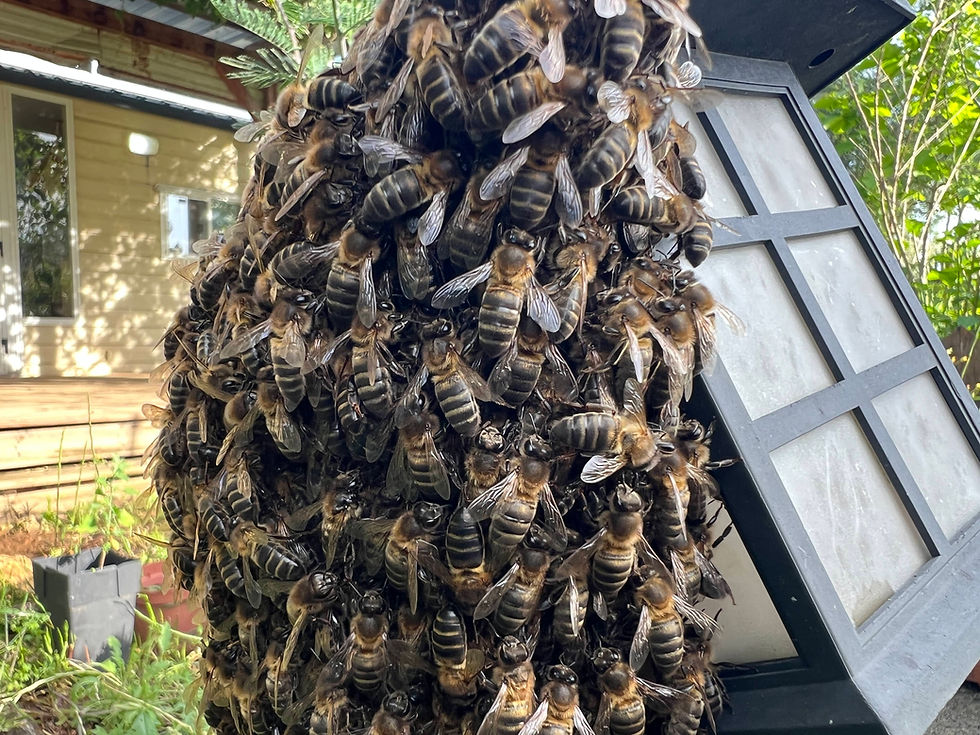
Not on a branch. Not in a hollow tree. Not in some poetic old stone wall. On a solar light.
At first, I stood there doing what any calm and skilled homesteader would do. I stared at the buzzing ball of bees and tried to look like I had a plan.
By evening, I did have one. I took an old wooden chicken box, closed it up as best as I could, and turned it into a quick emergency bee box. Once it was darker outside and the bees had settled, I carefully grabbed the whole stick with the solar light and moved the entire clump into the box.
The next day, bees were flying in and out. That was the moment this stopped being just a strange garden story and became a real question. My mother asked if the bees were actually beneficial. I told her I was convinced they were, mainly because of pollination. But her question stayed with me.
Are honey bees always good for a garden? Are they free farm helpers, or could they become a problem? And what does it mean when a swarm chooses your land in the first place?
This is our first answer from the Quinta.
Stick around until the end for Herman’s Tough Kraut Fixes, where I’ll cover the most common honey bee swarm troubleshooting questions, from old wooden boxes to random bee entrances and exact bee identification.
What Kind of Bees Are They?
From the photos and swarm behavior, these appear to be western honey bees (Apis mellifera), likely from the local Iberian honey bee lineage, though exact subspecies would need lab confirmation.
In Portugal, the local honey bee is commonly linked to the Iberian honey bee, Apis mellifera iberiensis, a western honey bee subspecies native to the Iberian Peninsula. Iberian honey bee genetics are complex, and imported queens or mixed lines can blur the picture, so I would not claim exact subspecies from photos alone. For that, you need proper morphometric or DNA testing.
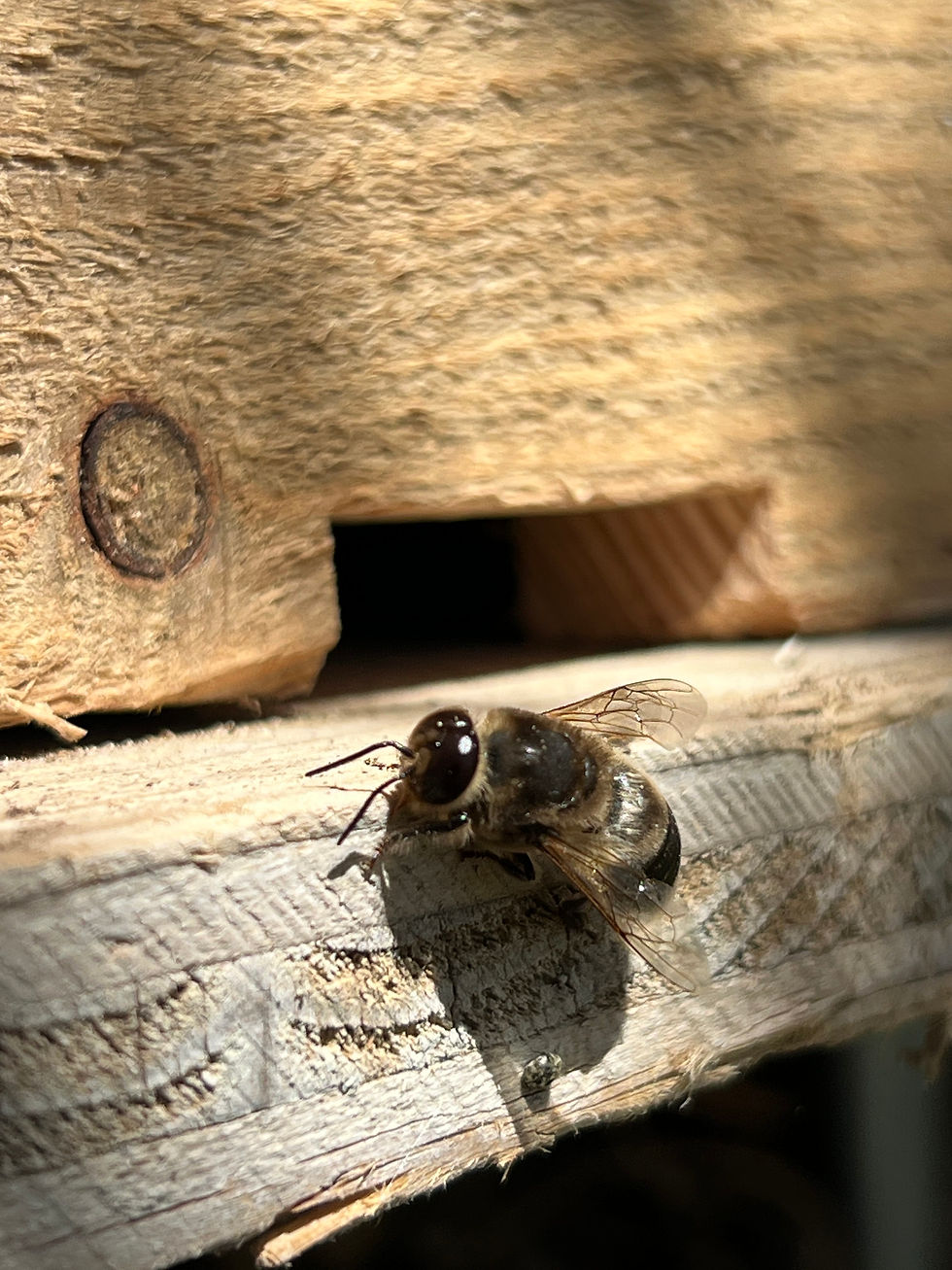
But the broad identification is clear enough for our purposes: this was a honey bee swarm.
A swarm is not a random mob of angry bees. It is how a honey bee colony reproduces. The queen leaves the old hive with a large group of workers, they cluster somewhere nearby, and scout bees search for a new home. That temporary cluster can look alarming, but it is normal bee behavior.
In our case, their first “temporary office” was a solar garden light. Their second option, after my intervention, became a retired chicken box above our veggie terrace. Not exactly luxury real estate, but apparently good enough for a first viewing.
How a Honey Bee Swarm Chose Our Quinta
The old chicken box now sits on top of an IBC tank, more than 3 m (10 ft) above the surface level of our veggie terrace. That height matters because the bees are not flying straight through our faces while we work below. Their flight path lifts them above the main working area, which is exactly what I want from tiny winged farm assistants.
The entrance faces east. That gives them morning light without the full punishment of the afternoon sun. The box also sits below the largest tree on our property, a huge old pine that throws enough shade to keep things calmer during hot days.
Because the chicken box is weathered, the boards are uneven. There are holes, gaps, and all the rustic charm of wood that has already lived one life with chickens. I made a small entrance, but the bees quickly chose one of the existing gaps as their main doorway.
Honestly, that feels right. I can prepare the box, but the bees decide how they use it. That is the whole low-interference idea in one sentence.
On top, I added a small piece of leftover drainage “nipple” foil to help shed rainwater. It is not fancy, but it keeps water from sitting on the old wood. The next improvement will be tying the box to the metal frame of the IBC tank below. Screws into a wooden board are a start. A full bee colony, wind, and old boards deserve a bit more backup.
Tough Tip: If bees move into an improvised box, think like a storm. Can wind shift it? Can rain enter it? Can the sun cook it? Can you work nearby without walking through the flight path? Bees like freedom, but your setup still needs basic safety.
Why We See Bees as Free Farm Helpers
Honey bees are famous for pollination, and for good reason.
As they move from flower to flower collecting nectar and pollen, they help many plants set fruit and seed. That can support fruit trees, herbs, vegetables, wildflowers, and flowering shrubs across the whole garden. For a self-sufficient homestead, that is not a small service. It is part of the food system.
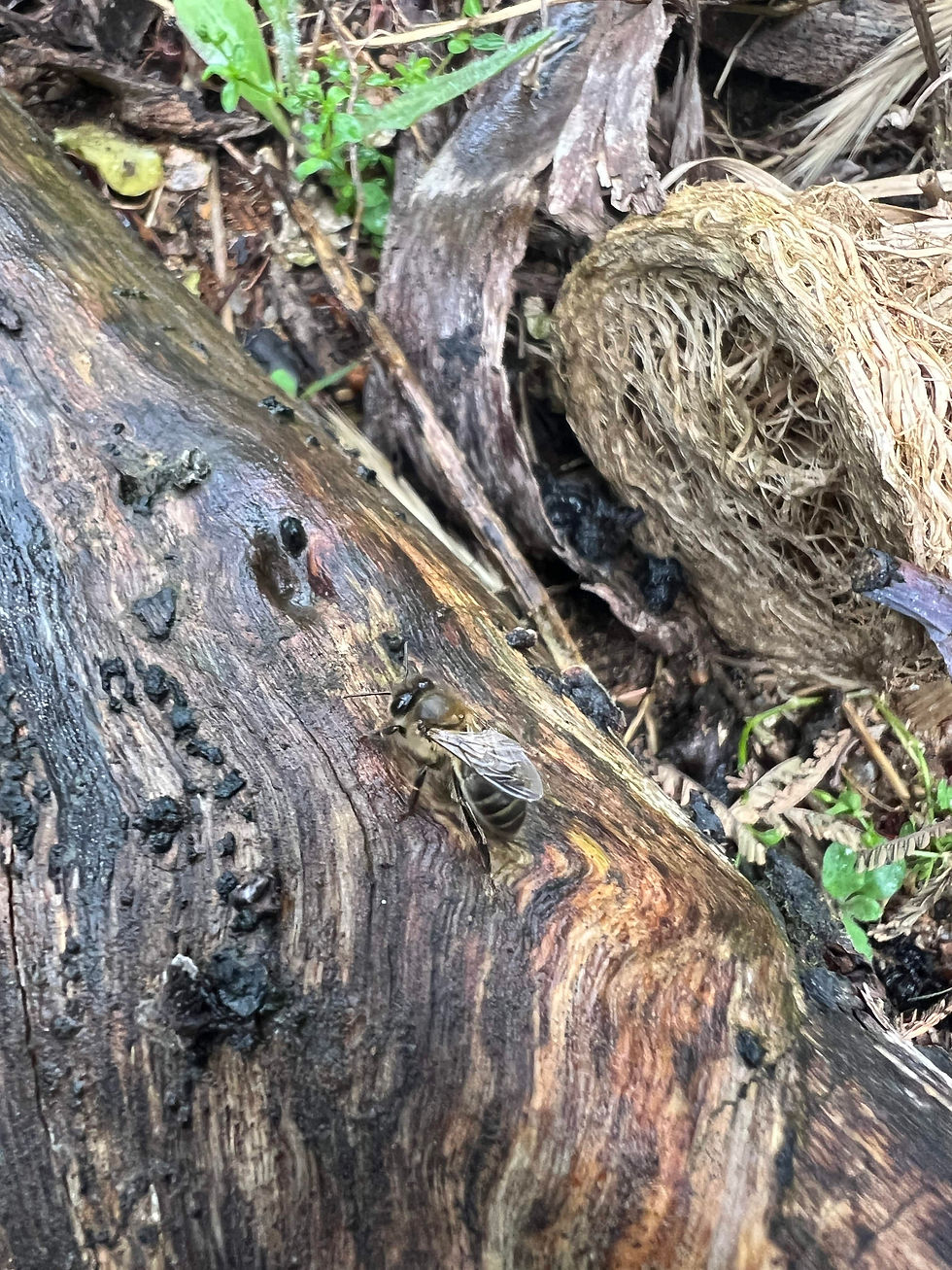
On our land, the bees can visit citrus, loquat, rosemary, lavender, thyme, sage, calendula, fruit tree blossoms, cover crops, wildflowers, and whatever else is blooming at the right time. They are not limited to our veggie terrace. Honey bees usually forage within a few kilometers when food is available, and they can fly much farther when needed. One apiculture fact sheet notes that bees can fly as far as 12 km (8 miles), though foraging is usually limited to food sources within about 3 km (2 miles).
Since our land is less than a hectare, that means one thing clearly: these bees can cover all of it with ease.
But they will not politely stay within our boundary like well-trained tenants. They will go where the nectar and pollen are best. Our trees, our veggie beds, the wild edges, the neighbors’ flowers, the river corridor, and the surrounding landscape are all part of their working map.
That is why I see them as free farm helpers rather than pets. I do not own their work. I can only make the land more worth visiting.
The benefits go beyond pollination too. Their presence tells us something about timing. When they are busy, something is blooming. When their flight changes, the season is shifting. When they gather water, the heat is speaking. A hive becomes another observation point in the system.
And for Tough Kraut, observation is half the work.
The Practical Side of Hosting a Honey Bee Swarm
Calling bees “free farm helpers” does not mean pretending there are no risks. Honey bees can sting. A fresh swarm is often calmer than an established colony because it has no brood comb and honey stores to defend yet. But once bees settle, build comb, raise young, and store food, they have something to protect.
That means respect matters.
I do not plan to open the box out of curiosity. I do not plan to feed them sugar water unless a knowledgeable local beekeeper says it is needed. I do not plan to move them again unless the location becomes unsafe. My goal is simple: interfere as little as possible and observe as much as needed.

The current setup has several things going for it:
The entrance faces east, which gives morning sun and avoids the hottest western exposure.
The pine tree gives shade.
The box is elevated more than 3 m (10 ft) above the veggie terrace.
The bees have chosen their own entrance gap.
The rain cover gives basic water protection.
The main thing to improve is stability. I will tie the box to the IBC frame so a storm cannot shift it. A hive that starts light can become heavy once comb, brood, pollen, and honey build up inside.
There is one bigger practical issue: this is not a proper framed hive. If the bees stay, they may build wild comb attached to the roof and walls of the chicken box. That is natural for them, but tricky for humans. It makes inspection, moving, or rescue much harder later.
That is the trade-off. A proper hive gives humans control. A rough box gives bees a cavity. Since my goal is low interference, I can accept some wildness. But I also need to stay honest about the limits of my setup.
Tough Tip: Low-interference does not mean careless. It means choosing the least action that still keeps the system safe, stable, dry, shaded, and respectful for both bees and people.
Are Honey Bees Always Beneficial?
Mostly, yes. In our context, I see them as beneficial. But nature rarely gives us simple yes or no answers.
Honey bees help with pollination, but they are not the same as wild bee conservation. A strong honey bee colony can compete with wild pollinators when flowers are scarce, especially where many managed hives are placed close together. Shared flowers can also become places where pathogens move between bees. University of Minnesota Bee Lab notes that when flowers are abundant, resources may support many bees, but when resources are low, honey bees can gain an advantage, and shared flowers can also spread disease.
For our land, one naturally arriving swarm is not the same as placing dozens of commercial hives in a stressed dry landscape. I do not see this as an ecological problem. I see it as a relationship to manage with awareness.

The best response is not to reject honey bees. It is to support the whole pollinator community.
That means more staggered flowers through the year. More native and Mediterranean-adapted plants. More herbs left to flower. More wild corners. More bare soil patches for ground-nesting bees. More dead wood, stone gaps, and undisturbed edges. And no careless pesticide use.
Honey bees can be part of a resilient system, but they should not be the whole system.
What the Bees Tell Us About Land Resilience
This swarm felt like more than a random event. When we arrived on this land, much of it was dry, compacted, and tired from past use. Since then, we have planted trees, added mulch, built soil, allowed more wild growth, observed water flow, and slowly shaped the place into something more alive.
A honey bee swarm choosing our Quinta does not prove we have “fixed” the land. Nature is not handing out gold stars. But it does feel like a sign that we are moving in the right direction.
There is shelter. There is shade. There are flowers. There is water nearby. There are old wood gaps and quiet corners. There are herbs, trees, weeds, and wild edges doing more than filling space. The land is becoming useful to more than just us.
That is the heart of permaculture for me. Not control. Not perfection. Not forcing every creature into a neat plan. It is creating conditions where life wants to participate. The bees did not ask permission. They arrived, judged the place in their own bee way, and started using it. That is humbling and oddly encouraging.
A few years ago, I would have seen a swarm as a problem to solve. Now, I see it as a conversation.
The Bee Box Under the Pine
My mother asked if the bees were beneficial. My answer is still yes.
Not because honey bees are perfect. Not because every swarm belongs in every garden. And not because I suddenly became a beekeeper overnight.
They are beneficial because they are pollinators, because they connect our garden to the wider landscape, and because their arrival shows that our Quinta is becoming more than a place where we grow food. It is becoming habitat.
The old chicken box under the pine tree is not a polished hive. It is weathered, uneven, patched with leftover drainage foil, and now quietly alive. The bees chose their own entrance, set their own rhythm, and reminded me again that nature does not wait until our systems are perfect.
Sometimes it just moves in.
For the Kraut Crew, that is the real lesson. Build soil. Plant trees. Let herbs flower. Leave some wild edges. Create shade, shelter, and water. Then watch who shows up.
Because one day, your free farm helpers may arrive as a humming clump on a solar garden light. And if you are lucky, they might decide your land is worth staying for.

Herman’s Tough Kraut Fixes: Honey Bee Swarm Troubleshooting and FAQ
A honey bee swarm can feel exciting, useful, and slightly alarming all at once. This troubleshooting section is for the practical questions that show up after the first buzz of excitement fades and you realize there may now be thousands of bees living near your garden.
This quick FAQ is based on our own swarm story here in Central Portugal, where an old chicken box became an improvised bee home above our veggie terrace. I am not pretending to be a master beekeeper. These are low-interference homestead notes for people who want to help without making a buzzing mess of things.
Q: Are honey bees good or bad for the garden?
A: Mostly good. Honey bees support pollination for many fruit trees, herbs, vegetables, and wildflowers. The main cautions are stings, hive placement, and possible competition with wild bees when flowers are scarce. The best fix is diversity: plant more flowers across the seasons and support wild pollinators too.
Q: Should I move a honey bee swarm into a box?
A: Only if it is safe and you know what you are doing. Swarms often move on by themselves, but if they settle in a risky place, a local beekeeper is the best call. In our case, I moved the whole solar light and swarm at dusk into a prepared wooden box. It worked, but I would not call it a beginner party trick.
Q: Is an old wooden chicken box good enough?
A: It can work as a rough cavity, but it is not ideal as a managed hive. Bees may build wild comb attached to the walls and roof. Keep it dry, shaded, stable, and ventilated. Then decide whether your goal is observation or beekeeping.
Q: What if bees use a random gap instead of the entrance I made?
A: Let them, as long as it is safe and dry. Bees are excellent at choosing usable openings. My tiny construction ego survived.
Q: How can I identify the exact bees?
A: Photos can support a general ID, but exact subspecies needs expert help. Take clear close-up photos, collect only naturally dead bees, and ask a local beekeeper association or lab about wing morphometry or DNA testing.
For more field-tested tools, propagation gear, and practical garden resources, visit the Tough Kraut Resources page.


Comments